Excipients are conventionally described through intrinsic material properties, pharmacopeial specifications, and functional labels such as binder, disintegrant, solubiliser, stabiliser, or release modifier. This vocabulary has supported pharmaceutical development for decades because it simplifies excipient selection and links material identity to expected product performance. Yet the same vocabulary becomes unstable when dosage forms are compositionally dense, structurally heterogeneous, and highly dependent on manufacturing history. The central problem is that excipient performance in complex dosage forms often deviates from what would be predicted by isolated material tests. A polymer that stabilises supersaturation in one amorphous solid dispersion may fail in another, while a lipid excipient that improves solubilisation under one digestion condition may promote precipitation under another. Such behaviour suggests that excipient functionality is not merely carried by the excipient molecule, but is produced within the dosage form system. This article proposes a theoretical reframing of excipient functionality as a system property. In this view, functionality emerges from the combined effects of formulation composition, spatial architecture, and processing history. The purpose is not to replace molecular or compendial characterisation, but to relocate those measurements within a broader systems framework. The proposed theory defines excipient functionality as an emergent outcome of interactions among drugs, excipients, process energy, phase behaviour, and microstructural organisation. It explains why apparently similar formulations can display different dissolution, supersaturation, release, or stability behaviours when their processing route or internal architecture differs. Three tables are used to contrast the reductionist and system-property paradigms, map overlooked interactions, and identify design implications. Adopting a system-property view would shift pharmaceutical development from selecting excipients as isolated ingredients toward designing excipient functions as relational outcomes. It would encourage formulation scientists to evaluate not only what an excipient is, but what it becomes within a particular dosage form. This perspective offers a conceptual basis for more predictive, adaptive, and robust pharmaceutical product design.
Excipients have long been treated as enabling materials whose functions are defined by identity, grade, and conformity to specification. The conventional paradigm assumes that material attributes such as viscosity, particle size, substitution pattern, moisture content, or compendial performance tests can predict how an excipient will behave in a drug product. This view remains useful for routine products, but work on excipient variability has shown that even pharmacopeially compliant materials can produce different biopharmaceutical outcomes when formulation context changes [1].
The reductionist view becomes especially fragile in complex dosage forms, where excipients no longer act as passive carriers but participate in phase behaviour, molecular mobility, interfacial assembly, and dissolution pathways. Amorphous solid dispersions illustrate this issue because polymer selection, drug loading, and release congruency can transform the same polymer from an apparent stabiliser into an insufficient inhibitor of crystallisation [2]. Lipid-based systems create a similar challenge, as excipient performance depends on digestion, solubilisation capacity, and precipitation kinetics rather than on lipid identity alone [3].
The practical consequence is a growing mismatch between excipient classification and product behaviour. Studies of solid dispersions, supersaturating systems, and lipid formulations show that dissolution enhancement, precipitation inhibition, and absorption support often arise from interactions that are invisible when excipients are tested in isolation [4, 5]. This mismatch matters because modern dosage forms increasingly rely on excipient-mediated control of non-equilibrium states, including supersaturation, nanodroplet formation, and metastable amorphous structure [6].
This article therefore argues that excipient functionality should be reframed as an emergent system property rather than a fixed intrinsic material property. The thesis is consistent with recent calls for deeper mechanistic understanding of supersaturating formulations and more context-aware quality-by-design approaches [7, 8]. Table 1 contrasts the reductionist and emergent system views of excipient functionality.
Table 1. Reductionist versus System-Property View of Excipient Functionality in Complex Dosage Forms
Dimension of comparison | Reductionist view of excipient functionality | System-property view of excipient functionality |
Ontological assumption | Functionality is treated as a stable property of the excipient material. | Functionality is treated as an emergent outcome of the dosage form system. |
Primary unit of analysis | The isolated excipient grade, specification, or molecular structure is the main focus. | The interacting formulation, including drug, excipients, architecture, and process history, is the main focus. |
Role of compendial tests | Compendial tests are assumed to provide sufficient evidence of functional suitability. | Compendial tests are necessary but insufficient unless interpreted in formulation context. |
Explanation of performance failure | Failure is attributed mainly to incorrect excipient choice, batch variability, or inadequate specification. | Failure is attributed to altered interactions, spatial arrangement, phase behaviour, or process-induced structure. |
Treatment of processing | Processing is often regarded as a manufacturing variable applied after formulation design. | Processing is treated as a formative element that creates or destroys functional architecture. |
Design implication | Select an excipient because it belongs to a known functional class. | Design the conditions under which an excipient can express the desired system function. |
Figure 1 illustrates the proposed shift from viewing excipients as carriers of fixed intrinsic functions toward understanding excipient functionality as an emergent system property generated by composition, architecture, and processing history.
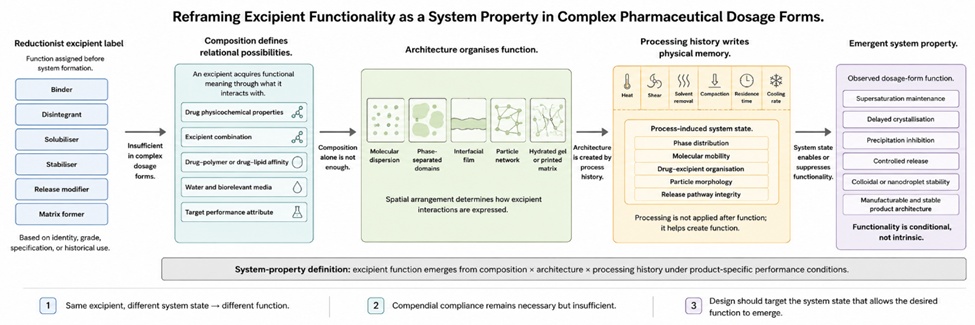
Figure 1. System-Property Model of Excipient Functionality in Complex Pharmaceutical Dosage Forms
The conventional theory of excipient functionality is closely aligned with the language of critical material attributes. Under this framework, excipient variability is translated into measurable properties, and those properties are linked to critical quality attributes through risk assessment and control strategies. However, biopharmaceutical studies of excipient variability show that the same nominal material attribute can influence apparent solubility differently depending on drug physicochemical properties and formulation environment [9, 10].
A systems-oriented theoretical basis begins by distinguishing material identity from material function. In amorphous solid dispersions, polymer chemistry matters, but the observed performance also depends on drug-polymer interactions, glass transition behaviour, water uptake, and whether drug and polymer release together or separately during dissolution [11]. Solid-state nuclear magnetic resonance studies further show that molecular-level interactions in dispersions are not abstract descriptors but structural relations formed within a particular processed material [12].
The systems view also draws from concepts familiar in materials science, including network formation, percolation, phase separation, and emergent mechanical or transport properties. Additive manufacturing of pharmaceutical dosage forms makes this especially visible because polymeric excipients must simultaneously enable printability, structural integrity, drug release, and manufacturability [13, 14]. In such systems, an excipient’s apparent “function” cannot be assigned before the architecture is created, because the functional state depends on the printed geometry, thermal exposure, and spatial distribution of drug and polymer.
A theoretical reframing also requires predictive tools that move beyond single-factor explanation. Recent work on amorphous solid dispersion design has used drug-polymer interaction measures, liquid-state compatibility concepts, and molecular simulation to anticipate whether a polymer will support a desired formulation outcome [15-17]. These approaches do not eliminate empirical testing, but they shift the object of prediction from the isolated excipient to the interaction network that the excipient helps create.
The first gap is the assumption that compendial adequacy and functional adequacy are equivalent. Lactose, hypromellose, and other common excipients may meet identity and quality requirements while still behaving differently in formulation because particle structure, hydration, substitution pattern, or process sensitivity alters system performance [10, 18]. Continuous manufacturing further exposes this gap because powder-to-tablet transformation depends on dynamic interactions among flow, compaction, lubrication, residence time, and equipment history [19].
The second gap is the weak theoretical treatment of processing history. Industrial experience with amorphous solid dispersions shows that the same drug-polymer pair may behave differently depending on whether it is produced by hot-melt extrusion, spray drying, or another route that imposes different thermal and shear histories [20]. Mechanistic studies of dissolution and crystallisation likewise indicate that polymer type and processing route shape the microstructure that governs release and recrystallisation [21].
The third gap is the tendency to interpret non-ideal performance as formulation noise rather than system behaviour. Lipid-based formulations demonstrate that excipient function is co-produced by lipid digestion, surfactant composition, bile and pancreatic fluids, supersaturation, and precipitation dynamics [5, 22]. Thermally induced supersaturation strategies also show that lipid excipient performance can depend on the path by which drug loading and metastability are generated, not simply on equilibrium solubility [23].
The fourth gap is that current development language often lacks a vocabulary for relational functionality. Lipid composition studies, 3D printing studies, and quality-by-design discussions all indicate that dosage form behaviour arises from coordinated material-process-structure relations rather than from isolated material identity [8, 13, 24]. Table 2 catalogues common complex dosage forms and the system-level excipient interactions that current reductionist approaches overlook.
Table 2. Excipient System Interactions in Complex Dosage Forms that Challenge the Intrinsic-Property Paradigm
Complex dosage form | Conventional excipient interpretation | System-level interaction often overlooked | Emergent functionality that may result |
Amorphous solid dispersions | Polymer is classified as a crystallisation inhibitor or solubilising carrier. | Drug-polymer miscibility, hydrogen bonding, water plasticisation, phase separation, and release congruency act together. | Supersaturation maintenance, delayed crystallisation, nanodroplet formation, or loss of dissolution advantage. |
Lipid-based formulations | Lipid and surfactant are classified by solubilisation capacity or digestion behaviour. | Digestion products, bile salts, pancreatic fluids, surfactant redistribution, and precipitation kinetics jointly determine performance. | Drug solubilisation, supersaturation, precipitation inhibition, or variable absorption support. |
Polymeric nanoparticles | Polymer is classified as a stabiliser, matrix former, or release-controlling excipient. | Interfacial arrangement, particle size distribution, drug-polymer partitioning, and processing-induced morphology interact. | Controlled release, burst release suppression, colloidal stability, or aggregation. |
Complex injectables | Excipient is classified by tonicity, stabilisation, viscosity, or depot-forming role. | Microstructure, phase transition, interfacial stability, and manufacturing history influence administration and release. | Injectability, depot formation, protein or particle stability, and sustained exposure. |
3D-printed dosage forms | Polymer is classified as printable, film-forming, or release modifying. | Thermal history, infill geometry, strand fusion, drug distribution, and polymer relaxation combine during printing. | Personalised dose architecture, programmable release, or print-induced instability. |
The proposed theory states that excipient functionality is an emergent system property generated by the triad of composition, architecture, and processing history. Composition defines what molecular and particulate entities are present, architecture defines how those entities are spatially organised, and processing history defines the energetic route by which that organisation was produced. Evidence from drug release, nanodroplet formation, and polymer-dependent solid dispersion performance supports the idea that functionality is expressed only when these three dimensions converge [6, 15, 25].
The first principle is compositional relationality. An excipient does not possess a single fixed function across formulations; instead, it acquires functional meaning through its relation to the drug, other excipients, water, biorelevant media, and the target performance attribute. This principle is illustrated by supersaturating amorphous systems, where polymer effectiveness depends on drug-polymer affinity, crystallisation tendency, and the molecular environment experienced during dissolution [4, 11, 16].
The second principle is architectural dependence. Excipients create function through spatial arrangements such as molecular dispersions, phase-separated domains, particle networks, interfacial films, printed matrices, and hydrated gel layers. Atomic-level studies of solid dispersions and additive manufacturing studies both show that structure is not a passive consequence of formulation but an active determinant of performance [12-14].
The third principle is process historicity. Processing does not merely convert a formulation into a dosage form; it writes a physical memory into the product through shear, heat, solvent removal, compaction, residence time, and cooling rate. This memory explains why industrial solid dispersions and continuously manufactured tablets can display performance differences that cannot be inferred from ingredient lists alone [19-21].
The resulting conceptual model treats excipient functionality as a conditional expression: an excipient performs a function only within a defined formulation-process-architecture state. Under this model, the relevant question is not whether an excipient is intrinsically a stabiliser, solubiliser, or release modifier, but whether the system conditions allow stabilisation, solubilisation, or release control to emerge. This model is testable because changes in composition, architecture, or processing history should produce measurable shifts in supersaturation, precipitation, dissolution, manufacturability, or predictive model performance [7, 8, 17, 23].
Amorphous solid dispersions provide the clearest example of why excipient functionality should be interpreted as a system property. Polymers in these systems are often described as precipitation inhibitors or amorphous stabilisers, but their observed function depends on whether the drug and polymer remain molecularly associated, whether release is congruent, and whether dissolution generates colloidal or nanodroplet intermediates [2, 6]. The system-property view therefore explains why the same polymer class may support supersaturation in one dispersion yet fail to prevent crystallisation in another.
The theory also clarifies the behaviour of lipid-based formulations, where excipient function is formed during digestion rather than fixed before administration. Lipids, surfactants, and co-solvents interact with bile salts, pancreatic enzymes, digestion products, and drug precipitation pathways, meaning that solubilisation capacity measured before administration may not predict absorption-relevant performance [3, 5]. Hybrid approaches that combine lipid-based delivery with amorphous solid dispersion concepts further show that excipient functionality can be distributed across multiple interacting formulation domains rather than located in one material [26].
Nanoparticle-based and complex dispersed systems similarly require a relational interpretation of excipient function. Polymeric excipients may act as matrix formers, colloidal stabilisers, interfacial modifiers, or release controllers, but these functions depend on particle architecture, drug distribution, interfacial composition, and manufacturing route. The broader trend in approved and investigational amorphous systems indicates that successful products increasingly depend on controlling such material-process-structure relationships rather than merely selecting excipients from fixed functional categories [27].
The system-property view can therefore guide pharmaceutical technology by asking which formulation state must be created for the desired function to emerge. In solid dispersions, this means designing drug-polymer interactions and release pathways; in lipid systems, it means designing digestion-responsive solubilisation and precipitation control; in printed or continuously manufactured products, it means designing architecture and process history together [19, 22]. Table 3 summarises practical applications of the system-property view for pharmaceutical design and quality assurance.
Table 3. Design and Regulatory Implications of Reframing Excipient Functionality as a System Property
Pharmaceutical design area | Reductionist practice | System-property practice | Practical implication for quality assurance |
Excipient selection | Choose an excipient based on known functional class and specification compliance. | Choose an excipient based on its expected interactions within a defined formulation-process system. | Specifications should be supplemented with system-context performance tests. |
Process development | Optimise processing after the formulation composition has been selected. | Treat processing as a co-determinant of excipient functionality and product architecture. | Process parameters should be linked to microstructure and performance, not only manufacturability. |
Dissolution and release testing | Use dissolution as a product performance test after formulation development. | Use dissolution to probe emergent release, supersaturation, and precipitation behaviour. | Dissolution methods should capture mechanistic transitions relevant to the dosage form. |
Scale-up | Preserve nominal composition and adjust equipment settings to match output. | Preserve critical system states such as phase distribution, particle network, thermal history, and release architecture. | Scale-up comparability should include structure-sensitive and process-history-sensitive measures. |
Regulatory assessment | Demonstrate that materials meet compendial and product specifications. | Demonstrate that excipient function is controlled within the specific product system. | Regulatory packages should justify how excipient variability, processing, and architecture affect performance. |
Reframing excipient functionality as a system property changes the logic of formulation design from ingredient selection to system construction. Instead of asking which excipient has the desired function, formulation scientists would ask which material relationships, processing conditions, and structural arrangements are required for that function to appear. This shift is particularly important for supersaturating systems, where precipitation inhibition and dissolution enhancement depend on dynamic interactions among drug, polymer, dissolution medium, and time [7]. In this view, an excipient is not selected simply because it belongs to a functional class, but because it can participate in a defined formulation state that produces the intended performance.
The immediate implication is that formulation design should begin with a target system state rather than with a list of preferred excipients. For an amorphous solid dispersion, the desired state may involve molecular dispersion, sufficient drug–polymer interaction, controlled hydration, delayed crystallisation, and congruent drug–polymer release. For a lipid-based formulation, the desired state may involve digestion-responsive solubilisation, controlled supersaturation, and inhibition of precipitation under intestinal conditions [22]. In both cases, excipient functionality is translated into a relational design question: what composition and process route can reliably generate and preserve this state?
This perspective also alters how critical material attributes are interpreted within quality-by-design. Material properties remain important, but their relevance should be established through their influence on formulation architecture, process response, and performance under biorelevant conditions. Critical material attributes should therefore be connected to critical system attributes, such as phase distribution, drug–polymer miscibility, interfacial structure, particle-network formation, or release-pathway integrity. Point-of-care and additive manufacturing strategies reinforce this need because quality may depend on local geometry, digital design, polymer behaviour, and process reproducibility rather than on material identity alone [8, 13].
The system-property view would also make excipient selection more mechanistic and less precedent-driven. A polymer, surfactant, lipid, filler, or disintegrant would be evaluated not only by grade, compendial compliance, and historical use, but also by its capacity to generate a desired interaction pattern within a specific formulation. This may require screening excipients under conditions that reproduce the relevant system environment, including hydration, thermal exposure, digestion, shear, compression, or solvent removal. Such testing would not replace specifications, but would supplement them with evidence that the excipient can express the intended function in the target dosage form.
Translation from laboratory to manufacturing would need a stronger account of process memory. A small-scale spray-dried or extruded dispersion may not be equivalent to its scaled-up counterpart if cooling rate, solvent removal, residence time, or shear exposure alters phase distribution and drug–polymer organisation. This concern is consistent with evidence that processing route and polymer choice can influence dissolution and crystallisation mechanisms in amorphous solid dispersions [21]. Scale-up should therefore aim to preserve functional system states, not merely reproduce nominal composition or conventional processing parameters.
This has important consequences for control strategy development. In a reductionist framework, control often focuses on incoming material specifications, process parameters, and final product tests. In a system-property framework, the control strategy would additionally monitor whether the manufacturing process creates the architecture required for excipient functionality. Relevant controls might include solid-state structure, residual solvent distribution, phase separation tendency, particle morphology, tablet microstructure, lipid digestion behaviour, or dissolution-mediated supersaturation.
Regulatory assessment would therefore benefit from product-specific definitions of excipient functionality. Rather than assuming that an excipient’s role is fully justified by precedent or compendial compliance, sponsors could define the system state in which that excipient performs its intended function and identify controls that preserve that state. Such a framework would align excipient selection, process design, analytical testing, and predictive modelling into a single translational argument [15-17]. It would also make regulatory justification more transparent by explaining why a given excipient works in one product but may not be interchangeable in another.
The broader translational implication is that excipient functionality should be documented as a conditional performance claim. A statement such as “the polymer inhibits crystallisation” would be less informative than “the polymer inhibits crystallisation when molecularly dispersed with the drug, processed under defined thermal conditions, and released congruently during dissolution.” Similarly, a lipid excipient should not be described only as a solubiliser, but as part of a digestion-responsive system whose function depends on lipid composition, surfactant behaviour, and precipitation kinetics [3, 5]. This form of documentation would support better formulation transfer, lifecycle management, and post-approval change assessment.
Finally, the system-property view encourages closer integration of experimental design, process analytics, and computational modelling. Multivariate studies can identify which combinations of material attributes and process variables create the desired system state, while predictive models can help prioritise excipient combinations before extensive laboratory screening. However, such models should be anchored in mechanistic understanding rather than treated as purely statistical correlations. The goal is a formulation science in which excipient functionality is designed, measured, justified, and controlled as an emergent property of the whole dosage form system.
Figure 2 presents a translation pathway for operationalising the system-property view by moving from target system-state definition to formulation–process co-design, system-context testing, predictive modelling, control strategy development, and regulatory justification.
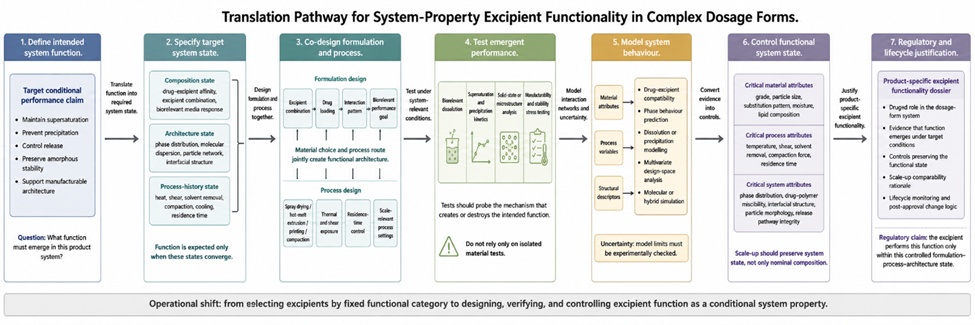
Figure 2. Translation Pathway for Designing, Testing, and Controlling Excipient Function as a System Property
The first limitation of the system-property view is practical complexity. If excipient function is emergent, then complete characterisation of every relevant molecular interaction, structural feature, and processing pathway may be impossible in routine development. Even in well-studied systems such as amorphous dispersions and lipid formulations, the relevant behaviour can include phase separation, digestion, supersaturation, precipitation, and molecular mobility over multiple time scales [4, 24, 25].
This complexity creates a risk of analytical overextension. A system-property framework should not imply that every interaction must be mapped exhaustively before a dosage form can be developed. Rather, it requires a disciplined prioritisation of interactions most likely to influence the intended performance attribute. The practical challenge is deciding which system features are critical enough to measure, model, and control.
The second limitation is the lack of standardised system-context tests. Current compendial and material tests are valuable because they are reproducible, transferable, and familiar, whereas emergent functionality tests may be formulation-specific and harder to harmonise. This creates a tension between the need for general standards and the reality that excipient performance may depend on drug properties, medium composition, processing route, and dosage form architecture [1, 9, 18]. The system-property paradigm therefore needs methods that are both product-relevant and sufficiently standardised for comparison across development programmes.
The third limitation is predictive uncertainty. Computational and multivariate approaches can support system-level thinking, but molecular simulation, compatibility prediction, and mechanistic dissolution modelling remain imperfect representations of real dosage forms. Recent modelling-oriented studies illustrate both the promise and the risk of overinterpreting simplified descriptors when the actual formulation system contains multiple coupled mechanisms [16, 17]. Prediction should therefore be treated as a guide to formulation reasoning, not as a substitute for experimentally verified system performance.
A final limitation is cultural and regulatory inertia. The pharmaceutical field has strong reasons to value established excipient categories, compendial tests, and precedent-based justification because these support consistency, comparability, and regulatory confidence. Moving toward a system-property view will require new terminology, new evidence standards, and closer coordination among formulation scientists, process engineers, analytical scientists, excipient suppliers, and regulators. The transition is therefore not only scientific, but also organisational.
This perspective has argued that excipient functionality should no longer be understood only as a fixed property of an ingredient. In complex pharmaceutical dosage forms, functionality emerges from the relations among composition, architecture, and processing history. The proposed theory therefore relocates excipient function from the isolated material to the organised dosage form system.
The conceptual value of this reframing is that it explains behaviours that the reductionist paradigm often treats as anomalies. Variable dissolution, unstable supersaturation, altered precipitation, process-dependent release, and scale-up sensitivity can be interpreted as consequences of changed system states rather than as unexpected failures of otherwise compliant materials. This makes the theory useful not as a replacement for existing quality frameworks, but as a deeper foundation for them.
The next step is to operationalise the system-property paradigm through better analytical methods, predictive models, and regulatory language. Pharmaceutical scientists, excipient manufacturers, process engineers, and regulators will need shared tools for describing how excipient function is created, maintained, and verified within specific dosage forms. Such collaboration would move the field toward more predictive, resilient, and innovation-ready product design.
None
None
None
None
Open Access The author(s) retain copyright. This article is licensed under the Creative Commons Attribution-NonCommercial-ShareAlike 4.0 International License. It may be shared and adapted for non-commercial purposes with appropriate attribution, an indication of changes, and distribution of adaptations under the same license. Third-party material may be subject to separate terms identified in its credit line. View the license at https://creativecommons.org/licenses/by-nc-sa/4.0/.
 Eurasian Academy of Medicine and Dentistry

