Royal jelly, a secretion produced by bees, has been previously shown to have beneficial effects on the nervous system. This study aimed to explore its potential in alleviating anxiety and controlling seizures in mice. To assess its anti-convulsant properties, 25 male mice were divided into 5 groups, with strychnine administered 30 minutes after royal jelly treatment to induce seizures. Key outcomes, including seizure onset and duration and mortality rates, were measured. A separate group of 35 male mice was used to evaluate the anxiolytic effect. Statistical analysis was performed using one-way ANOVA, considering P < 0.05 as significant. The results demonstrated that royal jelly doses of 200 and 400 mg/kg significantly delayed seizure onset and reduced seizure duration compared to the control group. In addition, the mortality rate in these groups was significantly lower than in the control group (P < 0.05). In the anxiety test, royal jelly doses of 50 and 100 mg/kg notably increased the stopping time and the number of entries into the maze arms compared with the control group (P < 0.05). These findings suggest that royal jelly effectively reduces seizures induced by strychnine and has potential anxiolytic effects in mice.
Seizures are disruptions in brain function caused by abnormal electrical activity in neurons. Various factors contribute to increased neuronal stimulation and the occurrence of convulsions, including hypoxia, metabolic alkalosis, infections, trauma, brain tumors, and hypoglycemia. In some cases, genetic defects are considered the primary cause of seizures [1-3].
Seizures can result in temporary alterations in physical, behavioral, and cognitive functions, which depend on the severity and extent of the brain’s involvement. These episodes can also lead to a variety of psychological and social impacts, with patients often suffering from conditions like depression, anxiety, and stress. Epidemiological studies report that anxiety affects 11%-25% of individuals with seizure disorders, likely due to the unpredictability of seizures, reduced daily activities, and social isolation [4-6].
Anxiety and worry are linked to several physiological changes, such as elevated blood pressure, heart rate, sweating, and increased breathing rates. Anxiety disorders significantly impact quality of life and individual well-being, leading to major disruptions in daily functioning [7, 8].
Current treatment options for seizures and anxiety disorders include a range of pharmaceutical drugs. Anti-convulsants like carbamazepine, sodium valproate, topiramate, and ethosuximide are effective in controlling seizures in many patients. However, long-term use of these drugs, often in combination with others, can lead to unwanted side effects, including gastrointestinal issues, neurotoxicity, and blood disorders [1, 9].
For anxiety disorders, newer drug classes like serotonin/norepinephrine reuptake inhibitors and selective serotonin reuptake inhibitors are commonly prescribed to alter brain catecholamine levels. Despite their benefits, these drugs often have limited efficacy for acute anxiety and come with side effects that reduce their appeal [10, 11].
Benzodiazepines are also used to manage seizures, anxiety, and panic attacks, but their use is associated with dangerous side effects, such as physical dependence, psychological addiction, withdrawal symptoms, and drowsiness [7, 12]. As a result, there has been an increasing interest in complementary medicine as a more affordable and lower-risk alternative for treating and preventing various neuropsychiatric conditions [13].
One of the widely used and safe forms of complementary medicine involves biological products, including royal jelly [14, 15]. Royal jelly is a milky, gelatinous secretion produced by worker bees through their hypopharyngeal and maxillary glands, and it serves as the primary nourishment for the queen bee. This substance is highly nutritious, containing various vitamins and minerals, such as calcium, magnesium, sodium, and potassium, as well as fatty acids (particularly 10-hydroxy decanoic acid), flavonoids, and trace amounts of sterols [16, 17].
Research has shown that royal jelly offers a range of benefits, including improvements in learning and memory, alleviation of menopausal symptoms, and reduced severity of premenstrual syndrome [16, 17]. Furthermore, studies have highlighted royal jelly’s potential in treating depression and anxiety, especially in an Alzheimer’s disease model induced by the neurotoxin trimethyl tin chloride in rats. The substance’s antioxidant properties help neutralize free radicals, such as superoxide ions and hydroxyl radicals, in the brain, which may improve cognitive function and help treat mood disorders associated with Alzheimer’s disease [18, 19].
Additionally, the effects of 10-hydroxy decanoic acid, the key active ingredient in royal jelly, have been studied both in vivo and in vitro. The findings suggest that this compound can promote neuronal growth, reduce neuronal damage in culture, and improve anxiety-like behaviors in mice [20]. Given these promising results, the current study seeks to investigate the protective effects of royal jelly in experimental models of seizures and anxiety in mice.
For this study, 60 young male NMRI small white mice weighing 25-30 g were selected. Of these, 25 mice were used to explore the anti-convulsant effects, and 35 were used to investigate the anti-anxiety effects of royal jelly. The mice were allowed to acclimatize to the laboratory environment for a week before the experiments began. They were housed in specific cages with a 12-hour light:12-hour dark cycle, maintained at 22-25 °C. They had ad libitum access to rodent chow and water except during the experiments.
Royal jelly, strychnine, and phenobarbital were utilized in this study. The mice were randomly assigned to five groups, each consisting of five mice. The negative control group was administered sterile physiological serum 30 minutes before receiving strychnine. The experimental groups were treated with royal jelly at doses of 100, 200, and 400 mg/kg body weight 30 minutes before the strychnine injection. The positive control group received phenobarbital, an anti-convulsant, at a dose of 40 mg/kg body weight 30 minutes before strychnine administration. All injections were intraperitoneal, and strychnine was given at a dose of 3 mg per kilogram to induce seizures. Strychnine acts as a glycine receptor antagonist, causing tonic-clonic convulsions in rats [21].
Following the strychnine injection, various convulsion indicators were recorded, including the time of onset (the interval between strychnine injection and the onset of tonic-clonic seizures), the duration of the convulsions (from onset until cessation or the animal’s death), and the mortality rate (the percentage of mice that died within 30 minutes of strychnine administration).
In this experiment, the potential of royal jelly to alleviate anxiety was studied, alongside the effects of diazepam for comparison. Mice were divided into five groups of seven and randomly assigned using a computer-generated random number table. The control group received only sterile physiological serum 30 minutes before testing, while the experimental groups received royal jelly at doses of 50, 100, and 200 mg/kg body weight. The positive control group received diazepam at 2 mg per kilogram of body weight, also 30 minutes before testing. Injections were intraperitoneal, and anxiety levels were evaluated using the elevated plus maze test.
The elevated plus maze is a widely recognized method for testing anxiety in rodents, consisting of two open arms and two closed arms, positioned 50 cm off the ground. Mice were placed in the center of the maze, and their behavior was tracked for five minutes, noting how often they entered the open arms and how long they stayed there. Video tracking was used for data collection, and the maze was cleaned between tests to prevent contamination. More entries into the open arms and longer durations spent there suggest reduced anxiety.
The data were analyzed using SPSS version 23 software, with Tukey’s test for pairwise comparisons and one-way ANOVA to assess group differences. A P-value < 0.05 was considered statistically significant.
The administration of royal jelly delayed the onset of seizures caused by strychnine in a dose-dependent manner. At doses of 200 and 400 mg/kg, there was a significant delay in the onset of seizures compared with the control group (P = 0.001).
Phenobarbital, used as a positive control, at 40 mg per kilogram, also delayed seizure onset when compared to the negative control group (P = 0.000). Both the 200 and 400 mg/kg doses of royal jelly significantly reduced seizure duration (P = 0.001). The phenobarbital group also exhibited a significant reduction in seizure duration (P = 0.000).
The 100 mg/kg dose of royal jelly showed some effects on seizure delay and duration, though these were not statistically significant. Mortality rates were significantly lower in the groups treated with 100, 200, and 400 mg per kilogram of royal jelly compared to the control group (P = 0.001), and a similar reduction was noted in the phenobarbital group (P = 0.000).
Table 1 outlines the results of the elevated plus maze test, showing the average time spent on the open arms and the frequency of entries into those arms under different treatment conditions.
Table 1. Effects of royal jelly on anxiety levels in mice using the elevated plus maze
Treatment | Duration in open arm (seconds) | Frequency of open arm entries |
Control (normal saline) | 8.3 ± 6.67 | 4.2 ± 1.1 |
50 mg/kg royal jelly | 4.8 ± 4.78* | 5.1 ± 4.4* |
100 mg/kg royal jelly | 78 ± 1.10* | 6.4 ± 6.1* |
200 mg/kg royal jelly | 68 ± 1.4 | 8.2 ± 8.0 |
2 mg/kg diazepam | 4.94 ± 3.9** | 6 ± 2.1** |
*Statistically significant difference from the control group (P < 0.05)
**Significant difference from the control group (P < 0.001)
Mice treated with 50 mg/kg and 100 mg/kg of royal jelly spent notably more time in the open arms compared to the control group, with this difference being statistically significant (P < 0.05), as shown in Figure 1.
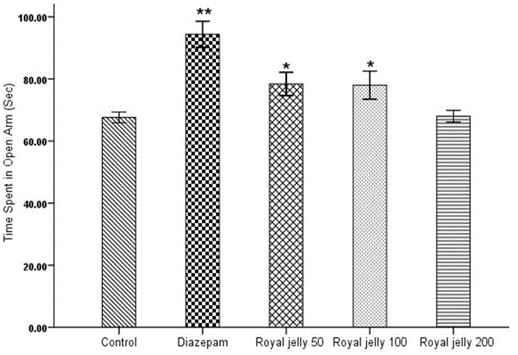
Figure 1. Effect of royal jelly on time spent in the open arms ( data are shown as mean ± SD; * and ** indicate statistically significant differences, P < 0.05 and P < 0.001, respectively, compared to the control group).
There was no significant variation in the time spent on the central platform across groups (P = 0.24). Moreover, the frequency of entries into the open arms was notably higher for the 50 mg and 100 mg royal jelly groups when compared to the control group (P < 0.05), as illustrated in Figure 2.
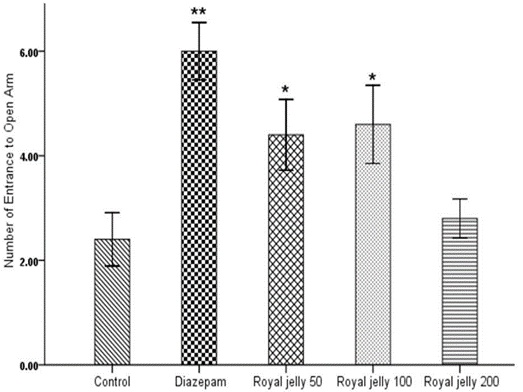
Figure 2. Effect of royal jelly on the frequency of open arm entries (data are presented as mean ± SD; * and ** indicate statistically significant differences at P < 0.05 and P < 0.001, respectively, compared to the control group).
The group that received the 200 mg/kg dose of royal jelly did not show significant differences in time spent in the open arms or the number of open-arm entries compared with the control group. Conversely, the diazepam group showed significant differences in all measured parameters (P < 0.001) compared with the control group.
The 200 mg/kg dose of royal jelly did not show significant differences compared to the control group for the observed parameters. However, in the diazepam-treated group, significant improvements were observed across all measured factors compared with the control group (P < 0.001).
This study assessed the protective effects of royal jelly on laboratory mice using a strychnine-induced seizure model and an anxiety test employing the elevated plus maze. In the seizure model, strychnine is used to trigger localized convulsions. These convulsions are confined to a small region of the brain, without affecting the entire brain, thus preventing the loss of consciousness. Some researchers have proposed that strychnine-induced seizures serve as a model for treatment-resistant epilepsy [22].
The results from this study revealed that royal jelly administration delayed the onset of seizures in a dose-dependent manner. Moreover, the duration of the seizures and the associated mortality were significantly reduced with royal jelly treatment. These results are consistent with previous studies, where phenobarbital effectively prevented strychnine-induced seizures.
In the anxiety assessment using the elevated plus maze, reduced time spent in the open arms and fewer entries into these arms were indicative of anxiety behaviors in the subjects [23]. The group treated with royal jelly showed increased time spent in the open arms and more frequent entries, suggesting an anxiety reduction compared to the control group. These findings align with those of Sefirin. [24], who observed reduced anxiety in ovariectomized female rats after oral administration of royal jelly in both the open field and elevated plus-maze tests. Moreover, these rats exhibited fewer flushing symptoms, suggesting that royal jelly may have estrogen-like effects on behavior.
In another study, Ito et al. [25] demonstrated that royal jelly, particularly its 10-hydroxydecanoic acid content, improved mood in a stress-induced anxiety and depression model in mice. Similarly, Pan et al. [26] found that three months of royal jelly consumption reduced the likelihood of cognitive impairments and Alzheimer’s disease in rabbits, likely due to the substance’s ability to decrease oxidative stress and reduce levels of malondialdehyde, acetyl enzyme, cholinesterase, and beta-amyloid in the brain.
Multiple studies suggest that oxidative stress and lipid peroxidation products like malondialdehyde contribute significantly to the development and worsening of seizures and anxiety. Free radicals increase glutamate levels in the brain, an excitatory neurotransmitter, and reduce GABA activity by inhibiting glutamine synthetase and glutamate decarboxylase [27, 28].
Royal jelly’s antioxidant properties help counteract these oxidative stresses by inhibiting hydroxyl radicals and superoxide ions. These effects are attributed to the bioactive compounds in royal jelly, such as flavonoids, polyphenols, 10-hydroxy decanoic acid, and various vitamins. Among the flavonoids in royal jelly, flavonols, flavones, and flavanones are the most prominent [29, 30].
Recent research indicates that these compounds not only possess antioxidant properties but also act as ligands for GABA-A receptors, mimicking the effects of benzodiazepines in the central nervous system [31]. Furthermore, depression and anxiety disorders are often linked to neuronal death in the hippocampus and the activation of inflammatory responses [32].
In a study, 10-hydroxy decanoic acid, the active fatty acid in royal jelly, was found to significantly reduce neuronal death and alleviate anxiety symptoms in aging rats [20]. These findings suggest that, in addition to royal jelly’s antioxidant effects, its anti-inflammatory properties and ability to promote neurogenesis may play key roles in improving the behavioral outcomes observed in this study.
The findings of this study suggest that royal jelly consumption reduced seizures and alleviated mood disturbances in laboratory mice. The active compounds in royal jelly, including 10-hydroxy decanoic acid and flavonoids, appear to contribute to these beneficial effects by reducing inflammation and mitigating oxidative stress. However, one limitation of the study is the lack of investigation into the molecular mechanisms by which royal jelly affects the central nervous system. Future research should focus on exploring these mechanisms. Additionally, clinical trials are needed to confirm the efficacy of royal jelly and establish the optimal dosage for treating neuropsychiatric conditions in humans.
None
None
None
None
Open Access The author(s) retain copyright. This article is licensed under the Creative Commons Attribution-NonCommercial-ShareAlike 4.0 International License. It may be shared and adapted for non-commercial purposes with appropriate attribution, an indication of changes, and distribution of adaptations under the same license. Third-party material may be subject to separate terms identified in its credit line. View the license at https://creativecommons.org/licenses/by-nc-sa/4.0/.
 Eurasian Academy of Medicine and Dentistry

